Wednesday, September 08, 2010

Rhossili

Last Saturday, September 4th, I went on a short trip to Rhossili, a small and remote village on the south-western tip of the Gower Peninsula. The weather was a little cool, breezy, and hazy, but we were still greeted by this lovely view along the famous beach:


This couple were among many enjoying the scenery:


Near the centre of the village is the Norman church of St. Mary's:


On the wall of the churchyard, I saw, appropriately, a Wall Brown butterfly, which, unfortunately, flew off before I could put my macro lens into action and photograph it.
We decided to take a quick peek into the interior of the church:


There is a plaque here in honour of Edgar Evans, a local man who died with Robert Falcon Scott - "Scott of the Antarctic" - on his ill-fated trip to the South Pole in 1912:


We then took a path through some fields as a short-cut to Fall Bay. The hedgerows were beginning to hang heavy with signs of Autumn, including these apples:


and these blackberries:


Arriving at our destination on the cliffs about fifteen minutes later, we looked to our right and were greeted with this view across the mainly-hidden (it was high tide) Fall Bay towards the distant Tears Point:
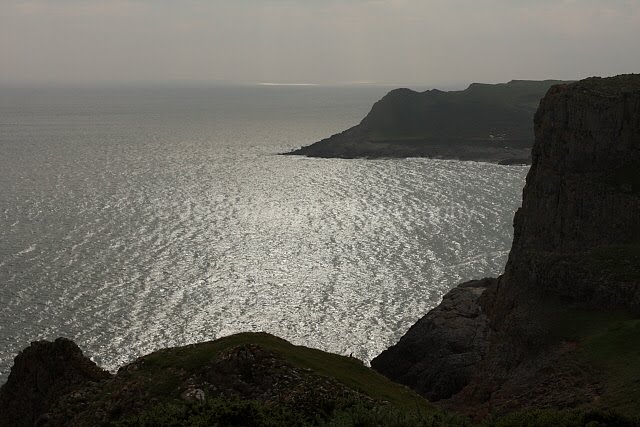

Looking to our left, a shaft of brief sunshine cast light upon the cliffs around Mewslade Bay (again, not really visible in the picture, due to it being high tide):


Walking along a bit further towards Mewslade, we paused for another look back across this cove towards Tears Point:


We were now on the cliffs between the two bays, and paused for some refreshments. Suddenly, two Peregrine Falcons appeared in front of us, flying at great speed, one following the other, across the sea from Mewslade to Fall Bays. One disappeared out of sight, whilst the other banked round, and began heading back towards us. I frantically began trying to switch my wideangle lens for my telephoto lens, hoping to photograph the bird as it flew over. Of course, I was too slow, and the Peregrine sped low above us, and I'd failed yet again to get any Peregrine shots. Darn it!
We waited around for a while, but there was no further sight of any Peregrines, so we headed back the way we had come. Accompanying us all the way in the fields around us were the Welshman's favourite animal, the sheep:


Once back in the village, the sun was beginning to shine, and I was able to take these pictures of the Worm's Head, a tidal island at the southern end of Rhossili Bay:


Before heading back to Swansea, we went into the local inn, The Worm's Head Hotel, for a drink:


and a meal:


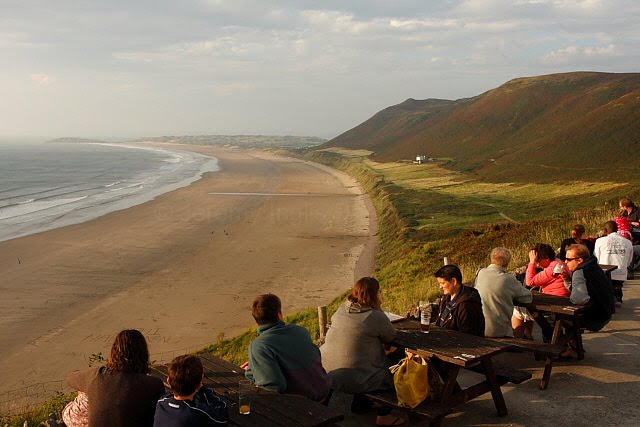
We sat outside on the pub's terrace, watching the evening sun shine onto Rhossili Down and Beach. It was a great place to relax on a late summer's evening; and, as you can see, several others had the same idea:

So, we didn't see too much wildlife on our walk, but it was a lovely place to spend a couple of hours.

Sunday, August 29, 2010

Butterflies

On Wednesday, August 4th, I went round to Caswell Bay on the Gower Peninsula near Swansea. I walked up through a grassy area above the bay, near Bishop's Wood, and saw a Silver-washed Fritillary butterfly feeding on the pathside flowers. I was very pleased, as I had only seen this species once before, and had no idea there were any in this area. Unfortunately, this individual was a little tatty, but I still took a couple of pictures:


Whilst there, I was also able to photograph this Speckled Wood butterfly:


The following night, I came down with sickness and diarrhoea, and was out of action for a week. (Maybe something to do with the dodgy takeaway sausage I ate at Caswell Bay!)
The few times I've been out photographing since, I've been concentrating on butterflies, as I've been having autofocus problems with my various cameras and lenses, which has ruled out most bird photography.
I've found 'Cabbage' Whites quite difficult to photograph, as they seem to be constantly on the move, so I was pleased to photograph this Large White on my first tentative walk out after illness:


I spotted my first Comma of the year in the same area:


I went round to Caswell Bay again, to see if I could see any more Silver-washed Fritillaries. No such luck, but I managed a couple of shots of Meadow Browns:


And another Speckled Wood:


There seems to be a glut of Small Tortoiseshells this year (unlike last year, when I hardly saw a single one round here). This individual was in the Botanical Gardens in Singleton Park:


There are still plenty of Common Blues flying around in the sand dunes on sunny days:


Along with smaller numbers of Small Coppers:


This Speckled Wood was posing obligingly on some Oak leaves on the edge of the local golf course:


There is a Buddleia bush on Swansea seafront which is blooming later than most of the others, and is thus proving a magnet to local butterflies, including the numerous Small Tortoiseshells:


and Red Admirals, which look great from the front:


or the side:


Last year, there was a large influx of Painted Ladies, but, until the last few days, I hadn't seen a single one this year. However, this bush has now pulled in a half-dozen or so of these beauties:


I also saw my first Peacock of the year a couple of days ago:


Thanks to those who have commented in my absence, and I hope to post more very soon!

Monday, August 02, 2010

Common Blues

The last few days have been mainly cloudy here, with occasional periods of sunshine. When the sun has shone, it has brought out plenty of butterflies to feed on the flowers in the dunes at the top of my local beach. 'Cabbage' Whites (Large and Small Whites) have been probably the most conspicuous, due to their large size and fast-flying ways, but I've also seen a few Small Coppers, and, today, a bright yellow Brimstone. However, the most numerous seem to be Common Blues. The males are particularly striking, and range from this tatty individual, feeding on Common Ragwort:


to this pristine specimen:


The females have a beauty of their own, their wing colour ranging from a dark brown, to blue with just a few brown markings:


Here's one in the wings-folded position:


And, finally, a mated pair:


I haven't done much butterfly photography, so hope to get out and sharpen up my techniques before the summer is gone.

Sunday, July 25, 2010

Skomer Island

Last Wednesday, July 21st, I made my first visit for four or five years to Skomer Island, an island nature reserve off the western tip of Pembrokeshire. I made my way to the small cove of Martin's Haven, from where we made the fifteen-minute journey to the island:


Once ashore, and after the obligatory talk from the warden, I decided to head up towards the old farm buildings in the centre of the island, as there had been talk of owls (Little and Short-eared) being spotted in the fields around them. I didn't see any owls, but, after I had turned left by the buildings, I did manage this shot of one of the many Rabbits that make the island their home:


There was a small bird hide (blind) a little further along the path to my right, and I decided to have a quick look to see if anything was about. First thing I saw was this Oystercatcher foraging quietly on its own in the mud very close in front of the hide. There are thousands of Oystercatchers on my local beach, but they never come close enough for any portrait pictures, so this was an opportunity too good to miss. The bird was too close for my 500mm lens, so I switched to my 70-200mm. It was very difficult to make a decent exposure of this contrasty-plumaged bird in the bright sunlight, but I did my best with the help of a little fill-in flash:


There was a pool in front of the hide, which was mainly full of a large number of Lesser Black-backed Gulls, which breed on the island:


Here's one of this year's offspring:


And an adult feeding its hungry 'child':


I'd like to have stayed here a little longer, to try for some better shots of the Oystercatcher in more overcast light, but we only had four hours ashore, so it was time to head for my main target, Puffins, and their main breeding grounds at 'The Wick':


Here, the Puffins are very confiding, seemingly unconcerned about the groups of people watching them, and will often come within a couple of feet of viewers. It enabled me to get a few decent shots, both with my 500mm and 70-200mm lenses, sometimes using an extension tube to enable the lens to focus close enough on the tame Puffins:


After a while, it began raining, at first gently, but then increasingly hard, and continued for about half an hour. I had a waterproof jacket in my bag, but decided to drape it over my camera and lens, and let myself get soaked. The conditions enabled me to get a few unusual 'Puffin in rain' shots:


Headshots were easy on the approachable birds:


A couple perched on the cliff edge:


Wing-flapping:


I saw a few Puffins with sandeels, but was unable to get the classic shot with sandeels in a bird's beak as birds landing with sandeels invariably disappeared straight down their burrows before photos could be taken. I also failed to get any decent flight shots as my Sigma 500mm f/4.5 lens just wouldn't lock on properly (I will have to send it off for repair soon). Anyway, I was reasonably happy with the shots I'd taken, and began meandering back along the coastal path towards the last boat back at 4 p.m. Along the way, I spotted two Peregrine Falcons flying around the Mew Stone, a large offshore rock. I was about to take a photo of a perched bird, when, of course, it flew off! I took this shot, one of the many Lesser Black-backed Gull youngsters, on my way back to the landing stage:


On the boat back to the mainland, a group of Gannets, no doubt from the nearby colony of Grassholm, flew overhead, and I was able to take this shot:


I had an hour or so before I needed to head home, so I walked up onto the headland overlooking Skomer, an area known as the 'Deer Park' (there are no deer here!). I was rewarded with this view back across to the island:


The area was ideal habitat for Choughs, and sure enough there were several family groups flying around, stopping to feed on the short turf:


I headed back down to the car park, and had just packed most of my photo gear away, ready to leave, when I saw what looked like a small bird of prey approaching in level flight along the small country lane. At first I thought it might be a Kestrel, but as I looked with my binoculars as it flew very low overhead, I could see it was a stunning Peregrine! I cursed the fact that I had just put my big lens in my bag, as I could have got some great shots. Oh well!
I contented myself with this shot of St. Brides Bay, viewed across a golden cornfield, before heading for home:


It had been a long and tiring day; but a good one!