Showing posts with label Mute Swan. Show all posts

Sunday, April 24, 2011

Mute Swans and Evening Abstracts

On an evening walk along the shore, I noticed two Mute Swans, an adult and a well-grown juvenile, incongruously positioned on the vast tract of sand that is Swansea Beach. I thought perhaps one of the two, which was sitting down throughout, was injured. In fact, as I approached to investigate, I realised it wasn't injured; just lazy! I was able to get quite close and take a few pictures with my 500mm lens:


A close-up of the 'lazy' adult:


The duller-beaked juvenile:


And the adult with a small feather on its beak:


Soon, the sun disappeared over the horizon, and I decided to try to capture the 'essence' of the scene before me, without any distracting details. To this end, I moved the camera from one side to another during an exposure of about two seconds to create these effects:


It's a bit of a hit-or-miss technique, but it was worth a try!

Sunday, February 27, 2011

Oxwich

On Friday afternoon, I felt the need to escape, but the rain was pouring down, so where could I go? I decided to pay a visit to the new hide at Oxwich Marsh on the Gower Peninsula. At least I'd be dry, even I didn't see anything!
Here was the view from the hide:


There were very few birds about: just a handful of Teal, almost hidden over the far side of the pond; a male Shoveler, which flew off after a few minutes; a fly-past Grey Heron, which my camera failed to lock on to; and a couple of Little Grebes, of which this was one:


I had heard that a female Hen Harrier had been around recently, which was the main reason for my visit. At one stage, as I was at the other end of the hide to my camera, I looked up only to see the said Hen Harrier quartering the reeds opposite the hide. I hurried back to my camera (there was no-one else there), but the bird had by now disappeared. Fortunately, it reappeared after five minutes, and I was able to take a few shots as it flew past at some distance. This is the only one where the bird is not facing away from the camera, although it's quite a big crop:


After this, the rain became a constant downpour, and I didn't see the harrier again in the remaining two hours I was there.
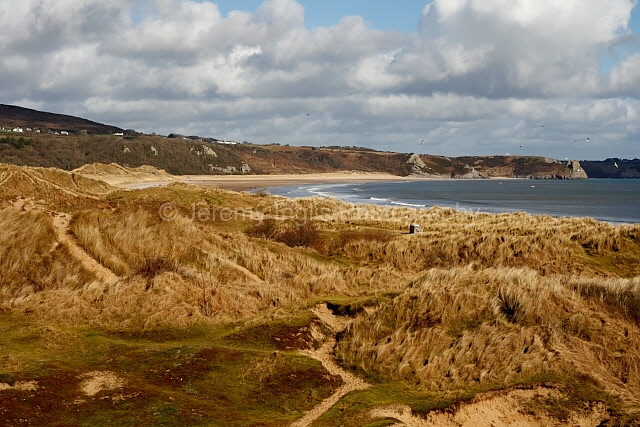
The weather was a lot brighter on Sunday, today, so I decided to head down there again. Before entering the hide, I took this shot looking across the dunes to Oxwich Bay:


Here was the view looking out from the right-hand side of the hide:


There seemed to be even fewer birds around than there were on Friday, although there were one or two almost-hidden Snipe on the small island just in front of the hide, and this drake Teal which came out into the open for a while:


Another Teal flew down to the left of the hide, and I was able to get this silhouetted shot as it floated on the sunlit water:


A small family group of Mute Swans were on the lake. Here are three of them:


I think reeds are stunning plants, and took a few shots of them whilst waiting for any birds to arrive:


Finally, about 4.30 p.m., a female Hen Harrier appeared from behind some distant trees, and I managed just this one shot of her (which is cropped to about fifty percent of the original frame):


About a half-hour later, I spotted the distant form of the beautiful, pale-grey, male Hen Harrier, circling over some trees. I managed a few shots, but they are so distant as not to be worth posting. Just before I left, I saw him roosting in the low branches of a distant tree.
There was just time for a couple of photos of the low-angled evening sunshine lighting the dunes:


and one more looking into the sunset:


before heading off.
I suppose there are worse places to live than Swansea!


Thursday, February 03, 2011

Sandy Water Park

On Tuesday afternoon, February 1st, I spent a few hours at Sandy Water Park, an area about a mile west of Llanelli town centre. It was formerly the site of the Llanelli Steelworks, but, since the early 1990s, it has been transformed into a country park, with a 16-acre lake being its main feature:


Situated above the lake are these Gorsedd Stones, the relics of a national Eisteddfod which was held here in 2000:


I had heard that a Bittern had been seen around the lake in the last few days, but I was unable to locate it. Instead, I threw a few breadcrumbs into the water, and was immediately surrounded by hordes of hungry water birds. Amongst the more usual species, were some Gadwalls, a species I hadn't really photographed before. Here is the female, which looks a little like a smaller version of a Mallard duck:


And the subtly beautiful male:


Sometimes one came too close to fit into the frame:


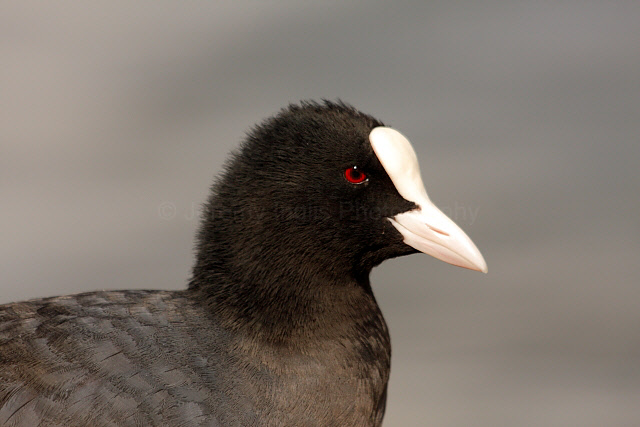
There were Coots by the score:


And plenty of Pochards, including this male:


A male Tufted Duck:


And a female of the same species:


These Mute Swans were ploughing through the lake's remaining ice like Russian icebreakers:


A female Mallard perched on the ice:


I walked westwards along the pond's southern shore, and fired off a few shots of passing birds. I got lucky when this Mallard flew close by, allowing a frame-filling shot:


This Tufted Duck also whizzed past at close range:


This Coot had some difficulty as it came in to land on the slippery ice:


Finally, a shot of a Mallard drake as the sun sank lower in the sky:


Thursday, September 09, 2010

Roath Park

On Tuesday, September 7th, I was visiting a friend near Cardiff, so decided to pay a visit to Roath Park whilst in the area. The park, which is owned by Cardiff County Council and is situated in a pleasant suburban area of Wales's capital city, is dominated by a large lake which is a haven to all kinds of birdlife:


If you look closely at this picture, you will see the Scott Memorial Lighthouse, which commemorates R. F. Scott's antarctic voyage of 1910 (see also my previous post):


As I arrived at one end of the park, I saw a Kingfisher whizz along the edge of the four small islands in this wilder end of the lake.
Some tall trees situated on one of these islands have become roosting sites for Cormorants:


From this vantage point, they launch off to look for lunch in the lake below:


Mallards, such as this eclipse-plumage male, are one of the lake's commonest birds:


As are the elegant Mute Swans:


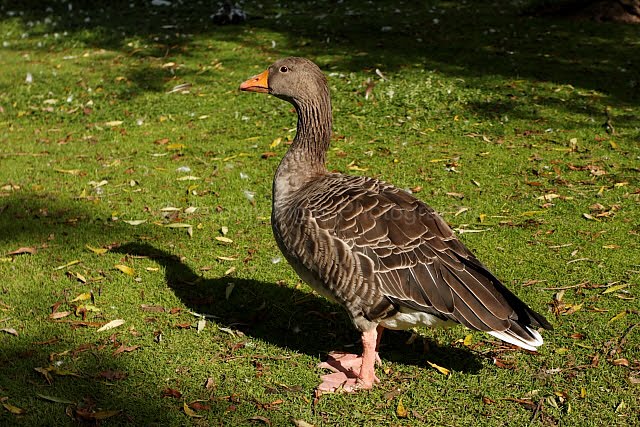
There is also a group of feral, free-flying, Greylag Geese:


Some of the many gulls include this winter-plumaged Black-headed Gull:


And this juvenile Herring Gull:


This Coot:


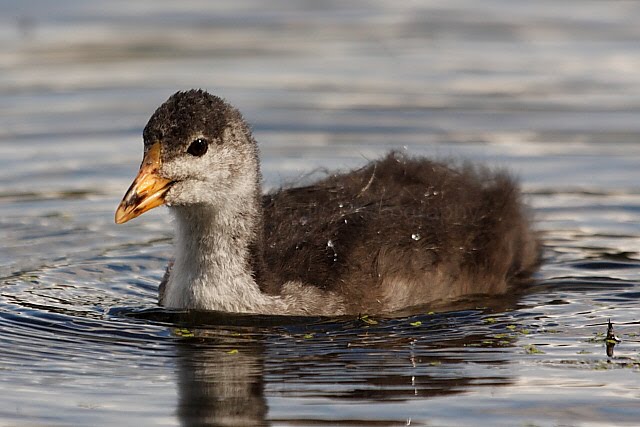
was closely followed by its offspring:


Soon after I arrived in the park, I spotted a pair of Great Crested Grebes with three young, but they were too far out from the shore for any decent photos. However, as I continued along the shore, I saw a small group of these lovely birds, consisting of two adults and five young, sheltering under an overhanging Weeping Willow tree. Here's one of the adults:


And one yawning:


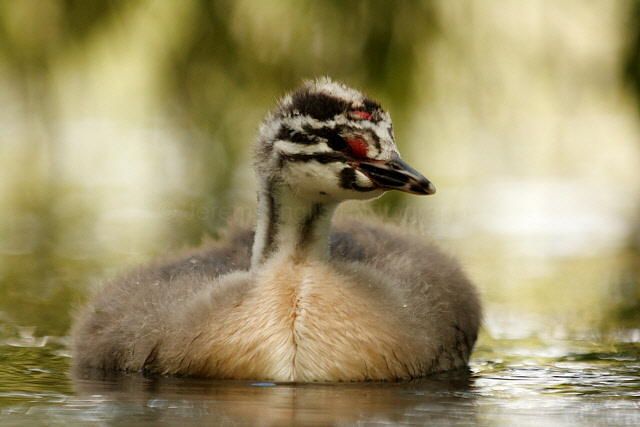
A couple of shots of the delightful youngsters:


Again, this adult was too close to fit completely into the frame:


A shaft of sunlight catches an adult's face, as it tends to its baby:


The dappled light made getting an even exposure quite difficult, so I decided to try a burst of fill-in flash for this picture:


I then began walking back from whence I had come, stopping for this wideangle shot of this approachable Greylag Goose:


Finally, as I neared the islands where I had started, I spotted the original Great Crested Grebes I had seen when I arrived, this time closer to the shore. I had time for this one shot, before heading off:


Definitely a place I must return to soon!